
Moore County Busted Mugshots
The Moore County Detention Center is the county's main lockup, run by the sheriff's office. The official Inmate Information portal searches it. Look someone up by name, by charge, or by who came in over the past few days. Clicking a roster row opens a detail view. Inside, you get the admit date and time, bond and court fields for each charge, the arresting agency, and a booking photo when one is attached.
One thing trips people up. Arrest, booking, and being held are three separate events. A city officer can make the bust, but the detention center only creates its own admission record once the person actually enters county custody. The agency field might name Pinehurst Police, Southern Pines Police, Carthage Police, the sheriff, or another department. The arrest file stays with the agency that made it. Admission and custody details belong to the detention system.
Read each record with care. A booking photo identifies one admission into county custody. It says nothing about later court action or where the person is now.
How Soon Do Busted Records Show?
The county promises no fixed refresh schedule for its roster. Intake paperwork has to happen first. So a one-day search window is a practical tool, not a promise of instant results. When timing matters, recheck the official form. You can also call detention staff for help routing your question.
Busted Charges and Bond Fields
Each charge in the detail view can carry a bond amount and bond type. Treat those as release conditions set at the booking stage. They don't tell you whether bond was posted or whether the person walked out. For anything that happened later, check the docket or the Clerk of Court.
Why Busted Records May Be Missing
Some records simply won't appear. Juvenile files, sealed cases, expunged matters, protected-victim details, and medical or other confidential material can be withheld or redacted by law. A person may also have been cited and released, transferred, or held somewhere else entirely. No private copy of a list can override a lawful restriction.
Who Got Busted in Moore County?
The honest answer depends on when and where the person is held. Check the county roster for current detention. Ask the city agency for an incident report. The court tells you how a case ended. NCDAC covers state custody, and federal or immigration locators handle those separate systems. Any copied list you find online is incomplete by nature.
Official Roster Interface
The Moore County current roster shows the text fields you get before opening a detail page. It's a good way to learn the official interface. A live display, though, is not a historical archive.
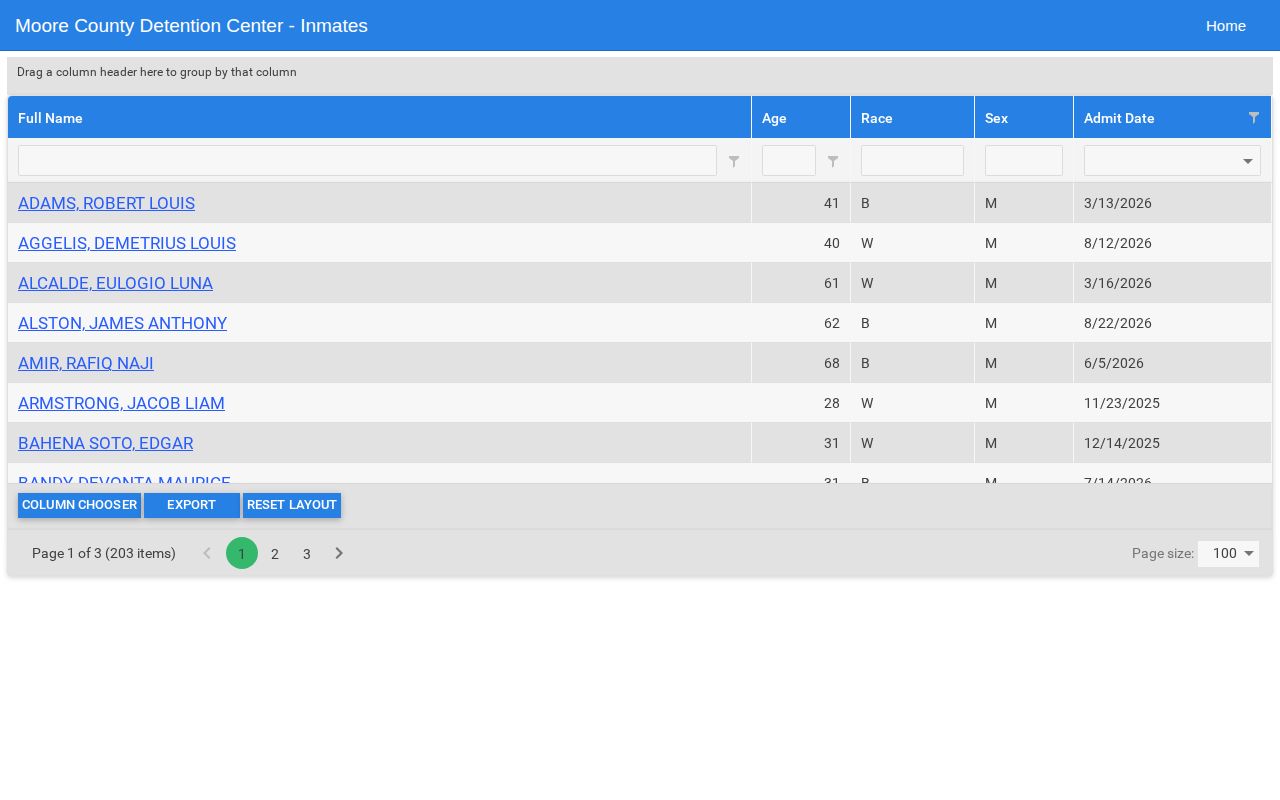
Keep your lookup tied to current county detention. Open a detail record only when the name, date, and custody context all line up.
Moore County Booking Record Fields
The live roster shows less than the detail record behind it. The list view carries Full Name, Age, Race, Sex, and Admit Date. Pick a row, and the detail page opens with the richer fields described here. Any field can sit blank, change later, or need confirmation from the record custodian. Address components exist in the portal too, though they aren't needed for a public records explanation.
| Field | What it shows |
|---|---|
| Full name | The name heading used by the detention system. Check spelling and possible name matches. |
| Age, race, and sex | Point-in-time roster fields. They are not identity proof and can differ from a later court file. |
| Admit date and time | When the person entered county custody, not the date of the alleged conduct or final case result. |
| Mugshot | A detail-page booking image when that record exposes one. The roster table itself is not a photo gallery. |
| Charge and offense date | The charge description entered at booking and the reported offense date. They are charges, not convictions. |
| Court type, date, and docket | Scheduling and case-reference fields that help connect the detention record to NC eCourts. |
| Bond and bond type | Charge-level release-condition fields. Do not add separate charge amounts or treat bond as a judgment. |
| Charging and arresting agency | The agencies associated with the charge and arrest. This helps route a police-record request. |
| Facility | Moore County Detention Center branding indicates the county-custody setting, not necessarily who made the arrest. |
No stable booking-number format appears in the official interface. For a records request, supply the full name, the rough admit date, a docket number if you have one, and any inmate identifier the portal itself displays. One more thing matters. The charge grid can list several charges at once, and court dates shift. Treat the booking record as a starting point and confirm later events with the court.
Request a Moore County Booking Photo
The sheriff and detention pages offer no dedicated online photo request form, no fee table, and no promised response time. Send a focused request straight to the Moore County Sheriff's Office. Name the exact record you want. The main office sits at 302 S McNeil Street, Carthage, NC 28327. Call 910-947-2931 for the main line or 910-947-2980 for detention questions. A sheriff's association directory also lists a Records Unit line at 910-947-7814 with hours of 9:30 a.m. to 6 p.m. Verify that number and schedule with the county before relying on them.
Requests move faster when they cover one person and one time frame. North Carolina's public-records law doesn't ask you to explain your purpose. Even so, don't request protected juvenile, victim, medical, confidential, or investigative material as if it were ordinary roster data.
- Identify the full name, any known spelling or alias, approximate admit date, and docket or inmate identifier if available.
- Name the item precisely, such as a booking sheet, inmate-incarceration record, charge and bond detail, or booking photograph.
- Ask whether the record is held, archived, or subject to a restriction, and request the legal basis for any redaction or withholding.
- Request an electronic copy or inspection and ask for the current duplication fee and delivery estimate before work begins.
- Use the sheriff’s main or detention line to route the request. The county self-service portal expressly excludes law-enforcement requests.
Moore County Sheriff's Office
302 S McNeil Street
Carthage, NC 28327
Main: 910-947-2931
Detention: 910-947-2980
Office hours: Monday through Friday, 8 a.m. to 5 p.m.
Two statutes govern all of this. G.S. 132-1 defines public records in broad terms, while G.S. 132-1.4 separates public arrest information from criminal-investigative material. No MCSO photo fee or turnaround time is published, so none is quoted here.
North Carolina Mugshot Record Law
No North Carolina law on the books targets booking photos directly. Nothing bans their publication, and nothing bans the pay-to-remove websites that profit from them. The state relies on its broad records framework instead. Under G.S. 132-1, photographs, documents, and electronic files created in the course of public business count as public records unless an exception applies. G.S. 132-1.4 puts basic arrest information in the open column while shielding portions of investigative files. Then there is G.S. 15A-502, which governs when fingerprints and photographs get taken at arrest, commitment, imprisonment, and certain conviction stages. Read together, these statutes permit access to a great deal. None of them orders anyone to keep a photo posted forever.
Not every record sees daylight, though. Juvenile files, sealed matters, expunged cases, and material tied to protected victims, medical details, or confidentiality rules can be withheld or redacted. So a blank spot on the roster tells you little on its own. The person may have been released, transferred, or issued a summons. The record may be restricted, or the arrest may have happened in another county entirely.
Expunction is the court process that can erase, seal, or destroy eligible state records of an arrest, charge, or conviction. The North Carolina Courts expunction information lays out the basics: eligibility varies, petitions generally go to the clerk in the county where the case was heard, and a $175 filing fee plus a several-month wait is common, though exceptions exist. File with the current expunction forms. Confirm specifics with the Clerk or an attorney. One caveat is worth remembering. An expunction order does not automatically reach private websites, so a separate lawful correction request may still be necessary.
Two bills, HB 778 and S 104, once floated changes in this area. Neither became law. Treat them as history, not as something you can cite. And be careful out there. Anyone demanding money to make a warrant or record vanish is a red flag, plain and simple. The reliable path runs through the government custodian of the record, plus any documented free correction process that genuinely fits your situation.
A few county-local third-party sites write their own correction rules, and those rules matter more than you might expect. RecentlyBooked's policy offers a no-fee review for certain records it classifies as incorrect, duplicated, juvenile, sealed, expunged, or resolved favorably. Busted Newspaper's removal form takes a simpler approach: submit the post URL along with supporting details. Neither decision changes anything official. The jail and court records stand on their own.
When Older Records Leave the Roster
How long does a mugshot stay online? The public Moore County portal sets no fixed photo-retention window. The State Archives sheriff schedule governs paper and files behind the scenes, not web visibility, and its timelines run short. Inmate Incarceration Records, which include entry and release summaries, detainee arrest sheets, commitment and release orders, and related confinement papers, are marked for destruction in the office three years after release or transfer. Inmate List Reports go when superseded or obsolete. Arrest reports follow their own path: five years when they sit outside a case file, and longer case-history rules once they enter a felony or misdemeanor file.
That split explains a familiar puzzle. An old Moore County mugshot vanishes from the live roster even though the sheriff or court still holds the underlying record. The reverse happens too. A private archive can keep its copy long after the official interface moves on. For older material, ask MCSO directly whether the file survives, was destroyed under the adopted schedule, or moved elsewhere. Records that entered a case file belong with the Clerk and the NC eCourts Portal. Two reference points can point you toward the right office: the North Carolina Archives schedule and the county-record finding aids. Neither is a ready-made county mugshot archive.
Local history groups can add useful background. The Moore County Archive project and the Moore County Historical Association both work in this space, though neither keeps current detention photos. For a real records answer, go to the official custodian.
Find Moore County Recent Arrests
The official search path is short, and every stop answers a different question. Begin with who is in county custody right now. From there, trace the agency that made the arrest and the court handling the matter. Someone missing from the list? That alone settles nothing, since absence has several innocent explanations.
- Open the Moore County Detention Center search form and search the inmate field by name.
- If the name is unknown, try a charge description or the “over last number of days” control for a recent window.
- Review Full Name, Age, Race, Sex, and Admit Date, then open the matching row for the detail fields and photo when available.
- Read the admit time, charges, docket, bond, charging agency, and arresting agency. Record the custody date rather than guessing from a news story.
- Use Pinehurst or Southern Pines Citizen Connect for municipal incident context, or contact Carthage Police because no separate Carthage online arrest log was located.
- Search the eCourts Portal by name, docket, or date to find hearings, amended charges, dismissals, pleas, and dispositions.
- If the live roster is not enough, send the narrow sheriff or originating-agency request described above.
What if a person is not listed? Several things could explain it. Release, transfer, a citation or summons, a juvenile or sealed matter, a different county, or simply a lag before the name posts. Choose the next source based on the person's custody status, not on whatever a third-party site turns up.
Where Moore County Busted Mugshots Appear
Start with official sources, always. Secondary publishers can surface a historical lead, but they carry real flaws: stale images, merged records, missing agencies, or charges that later changed. The table below lists county-local resources for orientation. None of them should be read as the last word.
| Channel | Photo? | Official? | Access and custody state |
|---|---|---|---|
| MCSO detention portal | Detail photo observed | Yes | Current county detention; search name, charge, or chosen days. |
| MCSO request | Ask for existing record | Yes | Released or historical county records; no published fee or deadline. |
| Pinehurst or Southern Pines Citizen Connect | Not a confirmed photo feed | Yes, municipal | City incident and report context, with arrest or daily-report tools. |
| NCDAC offender search | Photo not guaranteed | Yes | Sentenced state custody or supervision, not county jail. |
| NC eCourts | No booking gallery | Yes | Hearings, case events, and disposition after booking. |
| Busted Newspaper, RecentlyBooked, Mugshots.com, Arrests.org, Mugshots.zone | Often copied images | No | Unofficial county-local pages and archives. Verify every item. |
| Sandhills Sentinel, The Pilot, ABC11 | Varies by story | No, news outlets | Narrative crime coverage, agency releases, court material, or no photo. |
One common mix-up deserves attention. The North Carolina Department of Adult Correction search tracks people already sentenced to state custody, not the Moore County roster. A person can move from county jail into the state system, but this search will never tell you who got booked today. Federal and immigration systems sit apart as well.
For a sense of the unofficial landscape, the RecentlyBooked Moore County page serves as a recent-arrest index whose dates and counts shift constantly. Its interface is pictured here as a reference point. Treat it as a pointer, not proof that any listed entry is current.
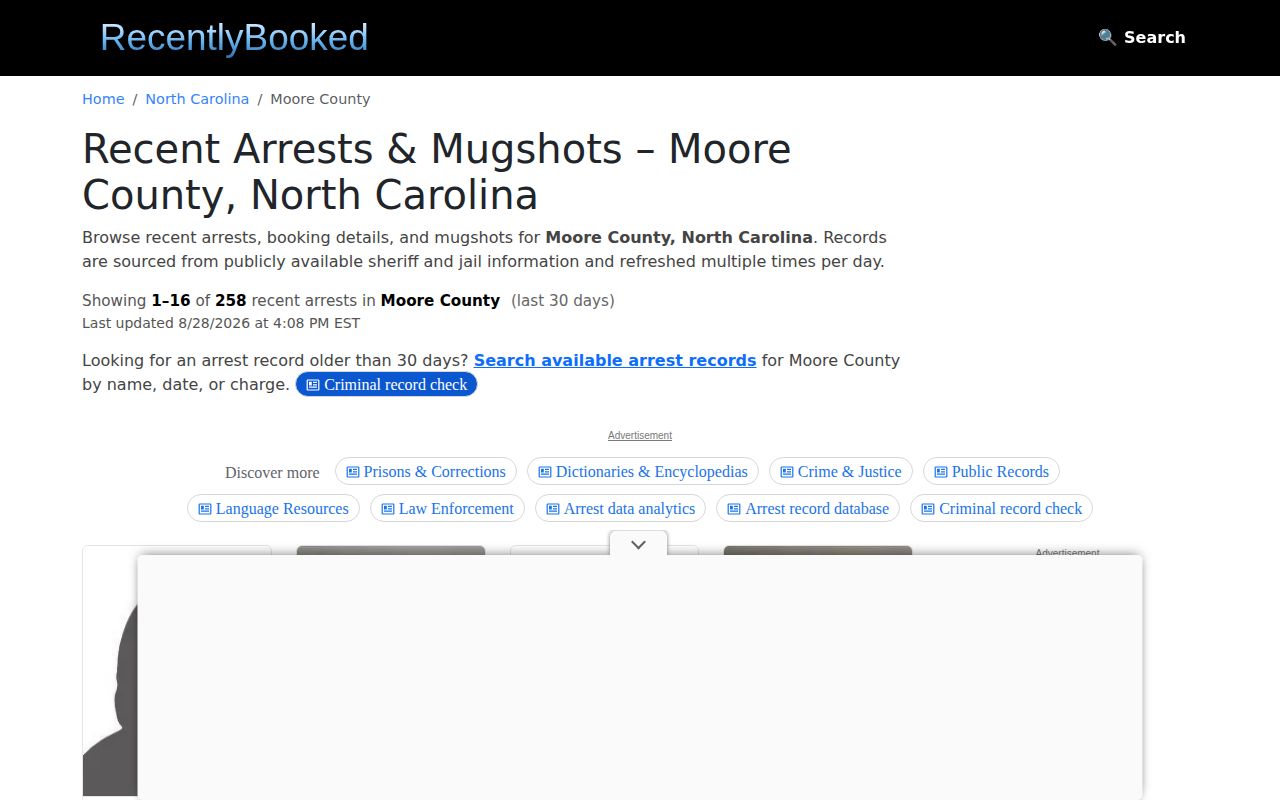
When you need the official custody answer, the route never changes. Go back to the county portal or contact MCSO. A private page cannot replace the originating record.
Moore County Jail Roster Search
Keep expectations straight about what the roster does. It shows current custody, not complete history. The official form gives three search paths, and the days control comes closest to a recent-bookings view. Moore County publishes no stable "today's bookings" feed URL of its own, so that filter is the practical option.
| Portal control | Use | What comes back |
|---|---|---|
| Inmate | Enter a person’s name or view all inmates | List fields, then a detail page with custody, charge, agency, court, bond, and photo fields when available. |
| Charge | Search by charge description or view all charges | Current entries associated with that charge wording; check the person and date. |
| Over last number of days | Enter 1, 3, 7, or another number | A generated recent window, not a separately archived booking feed. |
- Open the official form and choose the name, charge, or days route.
- Review the list fields, then select the correct row rather than relying on a name alone.
- Read admission, charge, court, bond, and agency fields on the detail view.
- Use the docket and name in eCourts for the later case path.
- If the row is missing or a field is unclear, use MCSO rather than a copied archive.
Moore County keeps its jail roster as plain text. Some detail pages add a booking photo, and a few show an enlarged image link. That is about all the county says. There is no published photo policy and no promised refresh schedule for the list, so treat images as occasional extras rather than a given.
Note: A current roster snapshot can include older admit dates, but that observation is not an online retention guarantee.
Recent Moore County Booking Windows
The booking portal asks how many days back you want to search. Type 1 and you get roughly the last day. Type 3, 7, or any other number and the window widens to match. That single field does all the work. Beyond it, the county offers no feed API, weekly archive, named 72-hour blotter, or stated update cadence for recent arrests.
One-day window: enter 1 in the form. What comes back is a look at admissions over the past day, not a guarantee that every arrest appears instantly. Multi-day window: enter 3, 7, or another number. The same list and detail fields apply, and older results stay a portal query rather than a standing archive. No-feed fallback: call detention for routing, request the record from MCSO, ask the arresting agency for its report, or check the court docket.
Processing can happen before anything shows online. Weekends and busy stretches add lag, though no official cadence exists. Pinehurst warns that some incident and accident reports take up to 72 hours to become available, but that notice covers municipal reports, not the county detention roster. Southern Pines runs its own Daily Report and incident tools. Carthage has no separate public arrest log. Private aggregators may span a longer date range. Their counts and copied fields shift, and refresh claims come and go. Use them only as leads. Then verify custody status, agency, and court outcome at an official source.
Moore County Alerts and the Sheriff App
The Moore County Sheriff NC app is an OCV tool. It handles news, tips, crime reporting, and notifications. The sheriff's page also links official Facebook and Instagram accounts. Nothing official promises the app mirrors the detention roster or carries every booking photo. Treat it as an alert channel, not a mugshot feed. NC SAVAN offers free, confidential notices. Register online or call 1-877-627-2826. It can track county detention, state prison, probation, and parole changes. However, it has no booking-photo search, and not every Moore County booking is enrolled. The county-linked CodeRED/OnSolve portal handles emergency and public-safety alerts. It is not a jail roster. Social posts may highlight selected arrests. Still, the detention portal remains the better source for current custody.
NCDAC State Offender Search
The NCDAC public offender search covers people in North Carolina state custody or supervision. It does not cover the Moore County Detention Center. Name and offender-ID paths are described in the agency's materials. Records reach back to 1972. Results focus on status, location, and identifiers. A photo is not guaranteed. Handy identifiers include a seven-digit offender number, docket number, county code, a jail transportation number starting with T, or a SID. Never guess one from a county booking number. Once someone is sentenced and transferred to state custody, NCDAC answers the state-status question while the county roster no longer does. It cannot tell you who entered the county jail today. Need a state record or photo the public result does not expose? Ask NCDAC's public-records contact. Keep that request separate from an MCSO request for the original booking record.
Note: A state offender result and a county booking detail describe different custody systems, even when they concern the same person.
Booked, Released, or Sentenced
Custody state decides where the record lives. A person can pass through more than one system, and the public tools do not all update at the same pace.
| Status | Best source | What it answers |
|---|---|---|
| Just booked or currently in county custody | MCSO detention portal | Visible admission, charges, agencies, bond fields, and detail photo when exposed. |
| Released or transferred | MCSO request, originating agency, court file | Historical custody or arrest details after the live roster changes. |
| After booking, court case active | NC eCourts and Clerk | Hearings, amended charges, pleas, dismissals, judgments, and disposition. |
| Sentenced to state custody or supervision | NCDAC search | State prison, probation, or parole status, not county jail information. |
| Federal custody | BOP locator and federal court | Federal inmate status. The public BOP locator has no booking-photo field. |
| Immigration detention | ICE locator | Qualifying current immigration custody. The reviewed interface had no public photo field. |
Federal custody needs different tools. The BOP Inmate Locator covers federal inmates from 1982 forward. Released statuses are included. The ICE Online Detainee Locator is a separate immigration search. A county jail entry with an immigration hold is not an ICE record. And the U.S. Marshals Service offers no general public locator for all federal pretrial detainees.
After a Moore County Booking
Booking is the intake step. An arraignment or first appearance is an early court event where the case and release conditions get addressed. Bond is a release-condition field, nothing more. Disposition is the court's later result, such as a dismissal, plea, or judgment. Court dates listed in the detention detail can change, so double-check before relying on them.
- Booking
- Jail intake that creates a custody record after a person enters the detention system.
- Arraignment
- An early court proceeding connected to the charge and case process.
- Bond
- A court or detention release-condition entry tied to a charge.
- Disposition
- The later court result that resolves or changes the case.
- Expunction
- A legal process that may remove, seal, or destroy eligible records under North Carolina law.
Search NC eCourts by party name, case number, or date. For an official certified copy, or an entry that is sealed, missing, or not yet indexed, go through the Moore County Clerk. The portal is a handy docket view. It is no replacement for a certified record.
Charges can be amended, reduced, or dismissed after booking. Read the court's disposition before treating any booking account as the final case result.
Busted Mugshots by Moore County City
City records and county custody records don't answer the same question. Pinehurst and Southern Pines both offer Citizen Connect tools for their residents. Carthage runs a police records function. It has no separate public arrest log or mugshot feed, though. Once a city arrest lands in county detention, the Moore County roster becomes the shared interface. That's where a photo appears, whenever the detail record includes one.
- Pinehurst Busted Mugshots uses Pinehurst Citizen Connect, its Arrests filter, and the county roster for county custody.
- Southern Pines Busted Mugshots pairs Southern Pines Citizen Connect reports with the county detention path.
- Carthage Busted Mugshots routes city records to the Carthage Police Department and county custody to MCSO.
Three city pages anchor this section: Pinehurst, Southern Pines, and Carthage. The first two are the county's largest municipalities in the 2020 population table. Carthage makes the cut because it's the county seat. Even so, Aberdeen counts more raw residents in that same table. The county-seat rule drives the choice.
Unofficial Moore County Sources
Beyond the official portal, the courts, and agency records, local news can fill in the story around a booking. Sandhills Sentinel runs a crime category and an arrests tag. Those pull together sheriff releases, multi-agency cases, municipal blotters, and coverage from communities across Moore County. The Pilot serves Pinehurst, Southern Pines, and the wider county. It offers no stable dedicated mugshot archive, though. ABC11 maintains regional place pages for Southern Pines and Aberdeen. A story might carry an agency image, a file photo, a court detail, or nothing at all.
Sites like Busted Newspaper, RecentlyBooked, Mugshots.com, Arrests.org, and Mugshots.zone host county-local sections. These may preserve copied booking-style entries. Their fields, dates, city labels, and removal rules all differ. None of these are official MCSO systems. None should outweigh a later court disposition, a lawful restriction, or a correction from the custodian. No photo appears on this page. And none of these outlets should be browsed as a gallery. When a local story catches your eye, note the source date and the agency named. Then go back to the official roster, the records unit, or the court. That chain keeps a fresh booking entry distinct from a released record, a state offender result, and a news summary.
Search Moore County Records
Sponsored Results